Today I'm showing you how I'd make a mythological creature 'real' in my writing.
I've chosen a rather random mythological insect, who hails from Greek Mythology, namely the Thriae.
 |
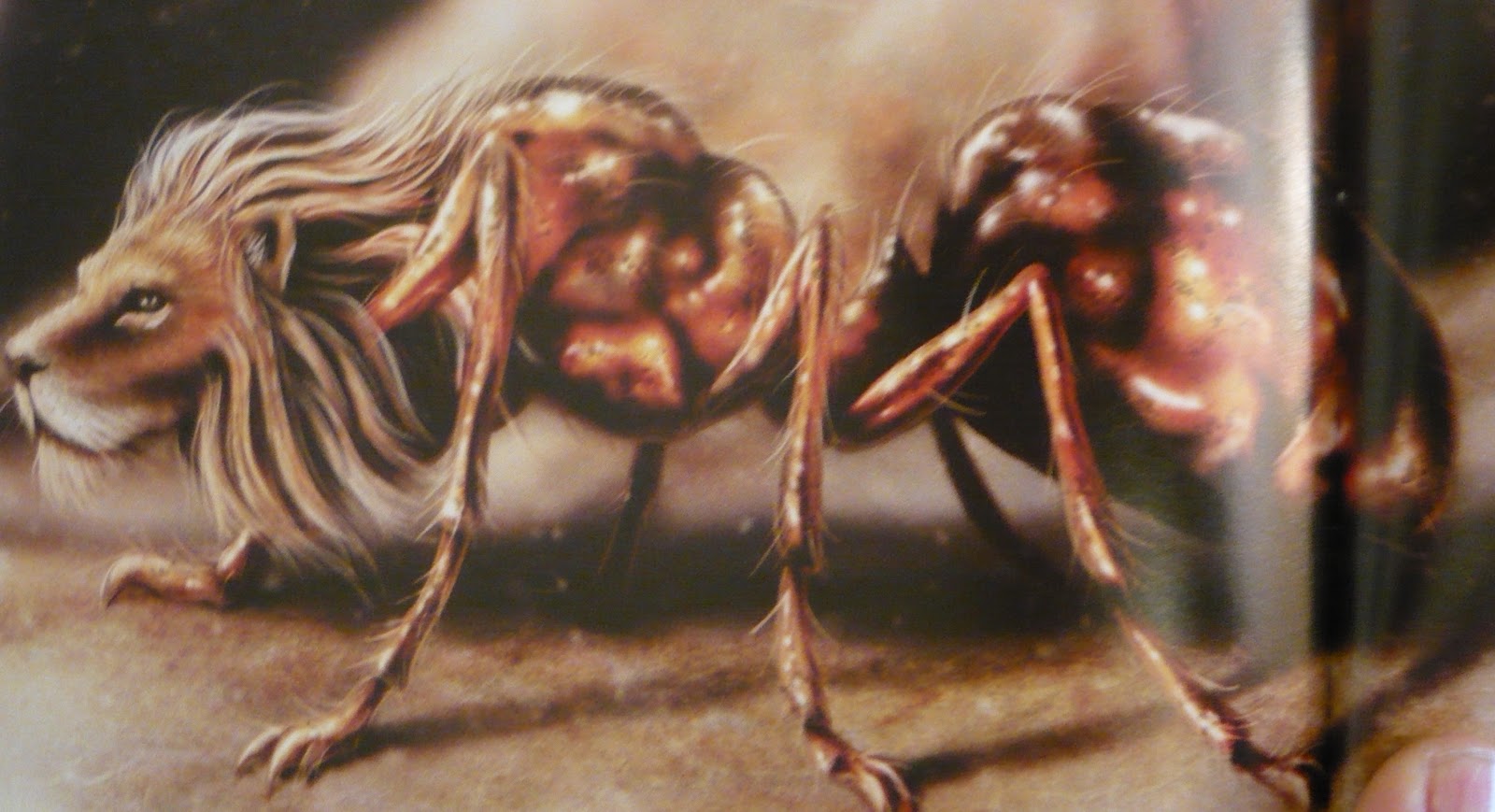
| [image; B. Rosen] |
Beastly Facts
Name: Thriae (also known as Thriai)Origin: Greek Mythology
Creep Factor: 1/10
Religious affiliation: Ancient Greek Pantheon
Deadly rating: Low
Cryptid: No
Shares similarity with: Melissae, Melissai
Brief and Basic History: The Thriae are closely linked to the Melissae (bee demigods/nymphs). Originally the Thriae were three nymphs (Melaina, Kelodora and Daphnis), who were oracles/soothsayers who used pebbles as a means of divination. The myths say that the nymphs were part woman and part bee, and lived somewhere around Mt Parnassos. They would tell fortunes and fed exclusively on honey, often they were described as being sprinkled with white/yellow meal, which was allegedly the pollen from the flowers.
Homeric Hymn 4 to Hermes 550 ff (trans. Evelyn-White)
(Greek epic C7th to 4th B.C.) :
[Apollon says to Hermes:] ‘There are certain holy ones, sisters born--three virgins gifted with wings: their heads are besprinkled with white meal, and they dwell under a ridge of Parnassos. These are teachers of divination apart from me, the art which I practised while yet a boy following herds, though my father paid no heed to it. From their home they fly now here, now there, feeding on honey-comb and bringing all things to pass. And when they are inspired through eating yellow honey, they are willing to speak the truth; but if they be deprived of the gods' sweet food, then they speak falsely, as they swarm in and out together. These, then, I give you; enquire of them strictly and delight you heart: and if you should teach any mortal so to do often will he hear your response--if he have good fortune. Take these, Son of Maia . . .’
 Without giving too much away, I intend on using a version of the thriae in my next book. To use such an unusual creature, I am going to have to work hard to make it realistic and believable. Below is a step by step guide of how I will do it.
Biological Realism is important.
Let face it, a human torso in insect body... How is that going to work...ever?!
Well, lets look at biology, and see how we can manipulate it.
a) Choose a type and a stick with it.
I am going to make my thriae almost entirely insectivorous, because mammalian vascular systems could never work in harmony with an insects - there are simply too many differences. Unless I'm going to use the blanket "it's just magic" comment over it, we're going to have to do some research.
b) Know your basic biology.
Google is great! I also have countless biology books in my home library (yes, I did Biology 101 at University). Look at the diagrams!

For example; Within the thorax/torso of my thriae, there will be no lungs. Being small and insectivorous they'd breath through spiracles and trachea. Therefore making them speak in a way that is intelligible to the average human is going to be problematic.
So how could I make the Thriae talk?
The biological realities are; that to speak they'd need vocal cords. Vocal cords are not muscles, but pieces of soft tissue with muscles surrounding them. These muscles around chords that cause them to loosen or tighten and it is the air passing through the vocal cords that make sound.
Here lies a big problem; the spiracles through which an insect breaths are located on the exoskeleton (thorax and abdomen, not the head). They allow allow air to enter the trachea. The tracheal tubes deliver oxygen directly to the small creatures tissues (this is one of the reasons that in our atmosphere insects can only grow upto a particular size as the respiratory system isn't complex enough to support a large body).
So assuming the thriae are insectivorous internally, and do not have lungs - they couldn't make vocal cords vibrate and therefore they couldn't speak through their mouths.
Hmmm. I have two options here, I can think of a way to make them speak biologically, or I can use literary license and say they speak through 'magic'. As I'm always up for a challenge, I like to investigate the posibility of speech through spiracles.
c) Do MORE research...
Ask yourself the questions!
Could spiracles move enough air to make sound? I don't know!!.. so I did some more research. discovered that there is a very special catepillar named the walnut sphinx catepillar that can actually whistle. It does this through contorting its body and pushing air through the spiracle. This only occurs at the eighth spiracle (article; http://jeb.biologists.org/content/214/1/ii.short). Woo hoo!
So, if I want my thriae to talk (which I do), they're going to have make speech-like sounds through their spiracles and some type of muscle and chord system arrangement there, not through their mouths.
Therefore with a few minor manipulations of biology, my thriae will be able to speak a pseudo human language, albeit not through their mouths, but rather though a hole somewhere near their arse.

Sorry, that was low brow.
There are of course other complications that will need to be addressed. For example the endo- verses exo-skeleton problem with the existance human torso/bee abdomen.
Well, I've already stated that they have bee-internals so I'm going to have to continue the insect-theme and give them an entire exoskeleton. To do this I'll look at some other insects that have interesting faces.
 |
| [stick insect] |
 |
| Bee |
 |
| damselfly. |
 |
| Dragonfly |
Strangely cute aren't they?
So now, I can imagine a humanish head, but add insect features to it.
They additionally would have no neck, merely a flexible joint between the the head and thorax. Additionally, the six legs of an insect generally all stem from the thorax (torso in the thriae). So we'd have to add segmented legs, that could be made to move the creature in a realistic fashion and a modified first pair of legs that the thriae would use as 'arms'.
d) Sketch it.
You don't have to be an artist, but give it a go, it will help you understand the dimensions of your creature better, and envisage its movements with greater ease. I love to draw and paint so I find this particularly enjoyable, and my pin-board is covered in random sketches :)Below is my sketch of 'my' thriae (complete with my cat's paw - he's everywhere you want to be).

Suffice to say, my thriae doesn't look as cute as the other images, but you get the idea. :)
Finally....
d) Remember this IS fantasy.
Yes, I like to go over the top with research to make things realistic, but it is also important to realise that the creatures of myth and magic do not have to be completely realistic to be readable. After all, they're not real. A biologist I'm certain would be able rip apart my biological reasonings and explain millions of reasons why things would probably not work. However, it's just that little germ of possibility, that adds something special to a novel.
It is also important to understand that despite all the research and cool facts you discover, the information must not dumped into the story like a text-book. Indeed, some of it may not be even mentioned at all. It's a shame, but when you come across a reader or fellow mythology/biology nut you'll always have something to talk about.
And on that note, enjoy your Wednesday!