Saturday, August 29, 2015

Black Sails S2, mirkins, manspiration and man love.


Well... well...

I've just completed watching Black Sails Season Two - and Lordy me did it throw a few surprise punches. Here's the good, the bad, and the bisexual. Oops. Did I give something away?

Here's the lo-down...

Firstly, I cannot tell a lie. There was PLENTY of delicious manspiration to be had.

Well hello Billy.... Nice to see you again.
Hold me back it's Captain Vane....I'm loving the boots.


Image result for Black sails Season 2 Vane sex
and the EVERYTHING!


Grrroar!

You are a Foo Eleanor Guthrie.

As any of you who have watched this series must understand - despite the panoply of tasty male morsels around every female character (with the exception of one) is bisexual, gay, or something in between. Clearly the Black Sails writers have been spending too much time with the Orange is The New Black writers - because at times Black Sails becomes a mirkin flashing, carpet licking fun fest... which is cool if you're into that kind of thing. Then, just as I was about say, "Hey this lady-love is getting a bit excessive..." the writers threw me for a six. That's right, they put in a bit of man-love, kicked in from left field... and not only that... from one of the characters you'd least expect...

***SPOILER ALERT***

Yes, you guessed it the hyper masculine, but quietly intelligent Captain James Flint had himself a lovely boyfriend before he became a pirate. You should have seen my husband's face at this revelation. It was hilarious.

I'm guessing that Flint is bisexual (like almost all the ladies on Nassau), and his romance is actually very, very sweet and ultimately very sad. James Flint can't seem to get a break this series.

There were a lot of ups and downs this series, and I did really enjoy it. There was less sexual violence against women which got a huge 'thumbs up' from me. In addition, I noticed a lot more rotten teeth, and chest hair too, a huge improvement from the first series where nearly everyone had good teeth and shiny hair free chests.

Anyway. Love your work STARZ, keep up the chest hair.


Friday, July 31, 2015

Having a Kraken good time... or not.


Image Courtesy: Pirates of the Caribean


Ah, the Kraken, recently re-made infamous by the Pirates Of the Caribbean franchise... but how much do you really know about this mythical sea monster? Other than the fact it looks something like a terrifyingly toothy butthole?


Allow me to enlighten you...

Name: Kraken, also known as Krabben, Skykraken.
Origin: Scandinavian Folklore
Description: enormous cephalopod / squid like, with mulitiple tentacles extending from the side of its body.
See also: Leviathan (see blog post here), Fastitocalon, Aspidochlone, Hafgufa
Cryptid status: active.

So what is the history?
 The first possible mention of the Kraken appears to be in the 13th Century Icelandic Saga of  Ã–rvar-Oddr. In this text two immense sea creatures known as Hafgufa and Lyngbakr are described. Researchers believe the Hafgufa may well be the earliest known reference to the Kraken.

The next mention of the beast appears to be in a Norwegian text describing the same Hafgufa as before, but it was not until Carolus Linneaus (an early taxonomist) classified the creature as a cephalopod that that the term Kraken came to popular use. The word krake (plural kraken) in Norwegian and Swedish means something like something twisted or unhealthy animal. In modern German, the word means octopus.

So what about the ship-eating myths?
 Well in Scandinavian traditions,  the kraken has a taste for human flesh, so targeted boats. Its preferred mode of attack was to encircle passing ships with its enormous body, and then create a whirlpool so that no-one and nothing could escape its attack. Legend has it that its hunger for man-flesh was so great that it would easily consume an entire fishing fleet in one sitting (or should that be swimming?).

Interestingly it was believed that the amber that regularly washed up on the shores of the North Sea was in fact Kraken shit... (that pretty amber pendant isn't looking so great right now is it?)

When at rest the Kraken is said to float on the surface of the ocean. There are several myths in which the dried skin of the beast could be mistaken for an island. Legends state that many sailors lost their lives mistaking the slumbering kraken for an island. The sailors would go ashore, light a fire for their tea and upset the mighty beast, and end up being dinner themselves.

Despite the Kraken being a terrifying creature, it is said that large schools of fish would seek harbour around it, and that if you were willing to risk it, you could get a great catch of fish by setting nets around its vicinity.

So what is the Kraken really?


It is most likely a species of giant squid. The largest giant squid ever recorded was 13 metres in length (43feet) long, and they are found all over the world in deep oceans. There are no modern documented giant squid attacks on boats, however squid attacks on humans can, and do happen. Increasing numbers of the Humboldt (or Red Devil squid) in places such as the Sea of Cortez have resulted in an increased number of squid attacks, which can be rather violent - as shown in the video.


Giant Squid
Image Courtesy Smithsonian Ocean Portal

As anyone who regularly visits my blog would know I am a massive fan of "making myths real"  so (much so that I did a series of blogs you can read, here, here and here...) and so I was delighted to receive an email from Christopher Stoll who is in the process of making a mythical creatures compendium... complete *swoon with joy* with anatomical pictures.


He has done some amazing pics, and one of those is of the Kraken.


Christopher's book will explore all kinds of awesome mythical creatures and will be a book I'll be waiting with baited breath for. I've left this post a little to late to help him out on KickStarter, but if you're a die hard mythology / cryptid fan like me, your support to his project would be much appreciated I'm certain. You can check him out HERE.

On that note... enjoy your weekend!

Wednesday, July 1, 2015

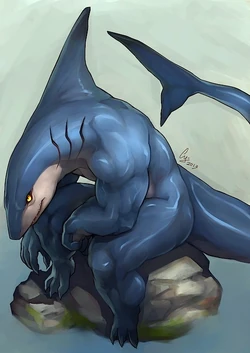
Sharks! Move over Jaws and meet Tumuitearetoka!


Yes, yes, we are all terribly familiar with JAWS and monster sharks lurking in the depths just waiting for your fleshy limbs to flail by before devouring you in a horrific and painful fashion aren't we?

Before you crap yourself about getting back in the water, I think I should introduce you to the amazing Tumuitearetoka, the king of Sharks, who hails from Polynesian Mythology and Kamohoalii of Hawaiian mythology.

D6ae868ecd43af810f32b49eb9f9451e
image courtesy: Wikia
We are so used seeing the shark depicted as something wicked and evil that some Polynesian mythology may  surprise you. In many of the Polynesian territories the Milky Way is traditionally represented as a shark, and is apparently called the "Long Blue Cloud Eater." This shark spirit can become man, in the form of tribal chiefs. These shape shifting chieftains can been good or evil depending on their personal preferences!

In Hawaiian mythology, Ka-moho-aliÊ»i is a shark god, and frequently swam the waters of Maui, whenever a boat was lost, the sailors would feed him an alcoholic kava drink and he would guide them back to their home port. It is alleged that Kamohoalii could also take the form of any oceanic fish. It is interesting however that Kamohoalii's son Nanaue's story isn't nearly as nice. Kamohoalii's boy unfortunately got a taste for human flesh... things got a little messy after that... You can read that myth here.

 There is also an interesting myth that I read about in The Element Encyclopaedia of Magical Creatures, by John and Caitlin Matthews. On the American Pacific coast a man and his wife were fishing, and instead of catching halibut they captured an enormous fish like they'd never seen. They cleaned and gutted it, but as she returned to the waters edge the wife was grabbed by Killer Whales. In desperation, the husband asked the Fish Chief where they would have taken his wife. He told the fisherman that his wife would have been taken as a slave because the huge fish they caught was a friend of the Killer Whales. Desperate now, the husband pleaded for anyone to come and help search for his wife. The only one volunteer was Shark. Together the man and Shark travelled to the home of the Killer Whales, where Shark grabbed the woman, throwing her into her husband's arms. He yelled at the humans to hurry away. When the people got to shore, behind them they could see a great fight happening in the water. To this day, Sharks and Killer Whales are still fighting...
Interestingly I could indeed find evidence of this.
© BBC Magazine – Peter Pyle/Oceanic Society
Image Courtesy: Discover Wild Life
I am going to warn you that if you look on youtube you may find some disturbing footage...

Now all this nice mythology is great, but as the story of  Nanaue suggests, not all the Polynesian shark myths are very nice. In fact they can be just as dismal as a Jaws sequel. One in particular is when Tumuitearetoka decided he would eat the Polynesian legendary hero Ngaru. Fortunately for Ngaru and every subsequent surfer, in an effort to out run Tumuitearetoka in the water, Ngaru is said to have created the first surfboard.

Another Fijian myth of the shark deity called Dakuwanga, says that the shark positively delighted in eating fishermen's fish, as well as the fishermen should they fall in. As it happens, the king of the octopus fought with him, and eventually they came to a deal, and Dakuwanga promised not to eat any more fishermen...

So perhaps you could say that despite the sharks scary appearance and nature, even the myths don't peg it as totally malevolent being... which some people (the Premier of Western Australia, Colin Barnett for example) should take heed of.
Sea Shepherd Australia

As you may know from my Facebook posts last year, am proud supporter of Support Our Sharks and Sea Shepherd Australia, organisations who are trying hard to save our increasingly endangered marine life, especially the top predators, who are suffering at the hands of humans through overfishing, shark finning and general ignorance about their importance in a healthy marine ecosystem.

On that note, I hope you found this post enlightening, I certainly found the research fascinating. Have a wonderful week!
Support Our Sharks Logo
Save Our Sharks


Book Ref:
Knappert, J.,1992, An Encylopedia of myth and Legend Pacific Mythology, HarperCollins.
Matthews, J&C., 2013, The Element Encyclopedia of Magical Creatures, HarperCollins.

Tuesday, June 2, 2015

The Krampus.... no, not cramp us....

So curtesy of a commenter, I'm doing a blog on the Krampus, a mythological beastie that hails from Germany...

If you're a fan of the TV show Grimm, you may have seen the episode on this guy... A Satyr-like Father Christmas gone terribly, terribly wrong...

So what is he? What does he do?
Allow me, as ever, to explain...

The most common description of Krampus is of a black haired human goat hybrid, who possesses a long red tongue, which frequently lolls out of his mouth.

It is believed by some academics that the Krampus has pre-Christian origins. It is commonly suggested that he is a form of the Pagan Horned God, and the birch sticks he carries are symbolic of his enormous phallus and the birch tree with which he is associated.

 Others theorize that Krampus is the son of the Norse Goddess Hel (daughter of Loki, who presides of the dead. You may remember her from my blog post about her brother Jormangandr.). Yet I cannot agree with this theory because I've never read of Hel having offspring - (please correct me if I am wrong).

The actual word Krampus is derived from the German word krampen, meaning claw, yet shares many features with Satyrs and several other vaguely demonic creatures scattered throughout mythology.

The myth of the Krampus is rooted in Germanic Christmas traditions. As in many Christian European nations, preparations for Christmas often begin in early December... and this is when the Krampus comes alive.

He is essentially the polar opposite of Father Christmas. Instead of bestowing gifts and lollies on good children, Krampus on beats naughty children with a birch sticks and drags them away to his lair to continue their punishment... I think we all know a child or two who may benefit from a visit from the Krampus rather than Santa...

According to the legend, he first begins appearing the night before December 6, known as Krampusnacht, or Krampus Night.
According to National Georgraphic, "December 6 also happens to be Nikolaustag, or St. Nicholas Day, when German children look outside their door to see if the shoe or boot they'd left out the night before contains either presents (a reward for good behaviour) or a rod (bad behaviour)."

So like many, many mythological beasties, the Krampus is a cautionary monster, frightening children into decent and socially appropriate behaviour.

Interestingly with the rise of Catholicism, fascism (and incidently science), in Germany in the 19th and 20th Centuries, the Krampus was a legend that became largely suppressed. However, it is now having something of a revival due to the rise in anti-Christmas celebrations.

The surge in interest in the Krampus, I personally believe has less to do with religious antipathy, but more of a rise in curiosity about mythology in general. In a society that believes science has all the answers, the thrill, magic and allure of the mythological world is almost palpable and something that people seem to be searching for more and more. You need only look at the popularity of Festivals of the Dead, Cosplay, supernatural investigations, paranormal themed movies, and even Krampus parades to see that people love to play with mythology even in our jaded 21st century.

Saturday, April 18, 2015

The Arassas...the...the...oh forget it...

QUICK FACTS
Name: The Arassas
Origin: French folklore.
Type: dragon (hybrid reptile / feline)
Danger Factor: HIGH

Imagine an cave dwelling animal... part cat, part lizard, of medium size.
I've lost you already haven't I?
Meet the Arassas...

Image courtesy: Culpeo Fox Deviant Art

The Arassas is a bizarre creature that hails from French medieval folk lore. They live in the French Alps, dwelling in caves, and rocky overhangs. As the French Alps span several countries, the Arassas has several names including:

  • Tatzelwurm ('claw wurm'), Praatzelwurm, or Lindwurm,  in Austria.
  • Bergstutzen  ('mountain stump'), springewurm ( 'jumping worm'), stollwurm, stollemvurm ('tunnel worm) and tazzelwurm  in Switzerland 
  • Daazelwurm and hockwurm in Slovenia.
You may be wondering why they are called 'wurms'. Well, a 'wurm' or 'wyrm' is said to be lowest 'species' of dragon. 

They live in the valleys of the Swiss, Bavarian, and Austrian Alps but historical sightings have been reported all over the Alps, including Spain, France, and Italy. The majority of reports however occur in Switzerland.

Most Arassas 'sightings' suggest that it is actually a rather diminutive creature, in some cases it is said to be no more than 91 cm, whilst others suggest they can grow to nearly 2 m. Descriptions (as always in mythology) are varied. Some say they are thin lizard like creatures, others suggest they are short and stocky. They also have flat heads, large eyes and short forelimbs. The skin is almost white, and some reports suggest scales. There is one report of a Swiss hunter claiming the skin was so thick he could not penetrate it with a knife.

The Arassas appears as the Tatzelwurm in many nineteenth century almanacs, bestiaries and guides of the Alps. That said, the body / skin / scat or any other physical evidence of its actual existence has never been studied.

There are however some interesting historical reports of it existence.
  • 1779, Hans Fuchs saw two Tatzelwurms appear suddenly, and the fright they gave him triggered a heart attack. He told his family about the encounter as he tried to recover. Unfortunately, he did not recover, and one of his family members painted a memorial to him, with two large lizard-like creatures a-lurk in the background.
1934 photo
  • 1828, a peasant in Solothurn, Canton found a dead Tatzelwurm in a dried-up marsh. He set it aside for a local professor, who later reported it to Heidelberg. The remains were lost in transit before they went to Heidelberg.
  •  1929, an Austrian schoolteacher reported spotting a Tatzelwurm. He said it kept staring at him, and when he went to capture the creature, it moved with the agility of a lizard, disappearing into a nearby hole. 
  • 1934, a Swiss photographer took an accidental photo of a Tatzelwurm poking its head out of a tree stump. The photo shows a blunt head and the forepart of a lizard, but it looks like a crude model. Many cryptozoologists consider this photography to be a hoax.
  •  6 February 1970, a story appeared in La Tribune de Geneve, a Swiss Newspaper. It was written by Georges Hardy. 

So what have these people actually seen? Or is the Arassas / Tatzelwurm just the workings of a delirious or insane mind?

The cryptozoologist Bernard Heuvelmans suggests this creature could be a relative to the Gila Monster of the American Southeast, or the Mexican Bearded Lizard. Both of these lizards have large, heavy bodies; scaly protective skin and dangerous bites.
I'm very sceptical about that. Although the Alps are home to a large variety of small lizards, none seem to meet the size suggested in the reports and the temperature variations of the Alps would kill both of these lizards.

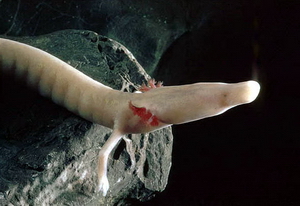
cave salamander, courtesy: Wikipedia
It's my personal belief that the  Tatzelwurm / Arassas is a fanciful fisherman's tale about some sort of amphibian, probably a relative to the Giant Salamander (check out my earlier post on River Monsters / Kappa) or  most likely an abnormally large Cave Salamander.

And that my dear readers is the lo-down on the Arassas. I hope you feel fully educated on the matter.

Enjoy your week!

Wednesday, April 1, 2015

Viveka Portman and Raunchy Regency


I'm in love with this genre. I have been for a long time, I just only re-discovered it recently.

Viveka Portman writes a very particular brand of racy, raunchy Regency Romance.

Two of her books have been finalists in the Australian Romance Readers Awards for best Erotic Romance.

Her latest release 'Observations of a Curious Governess' is book 4 in the Regency Diaries series - and gives the reader another, closer glimpse behind the doors of Lord Stanton's home. This is, according to Portman her favourite story in the entire series.
It is the diary of a young, naive, but curious young Governess, who realises that although her professional calling provides a level of independence a woman otherwise would never enjoy, she's missing something else. Something more potent and entrancing than even the independence she has longed for. So, suffice to say, she goes about trying to find a way to enjoy both.

It is a great read.

The final instalment in the Regency Diaries is 'The Journal of a Vicar's Wife', is due for release in July. Some of the attendees of the Australian Romance Reader's Convention in Canberra last month were lucky enough to be treated with a live reading of one of her more 'outrageous' sex scenes, from this upcoming title. Which went down very well, or so I've been told. ;P

So if you want to support an Aussie writer, give Viveka's Regency Diaries a go. I don't think you'll be disappointed!

Sunday, February 15, 2015

Otherworldly erotica... yes I'm going there.

buy link
So... what have you been reading lately?

With titles like Taken by the T-rex, Mounted by a monster, or some such - there seems to be a plethora of 'out there' erotic reads available in the modern market - that seemingly sell very well.

I usually avoid them.

This time I didn't.

Recently, I dared to dip my toe into the murky waters of self-published erotic e-books.


You may indeed ask why, for I certainly have asked myself that same question...


buy link

I have admittedly turned my nose up to reading these kinds of books for quite sometime. Whether it has been my literary snobbery, my distrust of self-published books or my distaste at the content - I can't be sure. So when I was first introduced Rosemary Button's Alien Games I was a little bit squeamish, a little bit embarrassed but ultimately pleasantly surprised.

It was actually rather good.

The premise is great and it's witty, strangely romantic and completely out-there in the way only a sci-fi erotica novel could be. Combine that with some decent editing, and a good story arc, and well, you have a strange, but very easy read.

buy link
Was it sexy, you ask? Well, that depends on what you find sexy really... Some of it yes, other bits no.

Still, it's given me a great insight into why some people are devouring these books (some of which are as short as 3000 words). They're quick to read, titillating, and the ultimate in escapism.

Will I read more of them? Rosemary Button? Certainly. The other's... maybe, if I see one that tickles my fancy.

In truth I don't really know what it says about society, but the rise in short-length otherwordly erotica is certainly a fascinating phenomena and one I will be watching with interest from now on.